
The “Zero-Bloat” Architecture: Optimizing for Core Web Vitals
The modern web is suffocating under the weight of bloated JavaScript frameworks and excessive third-party scripts. Speed is no longer just a metric; it is a fundamental feature of user experience and a critical ranking factor for Google’s Core Web Vitals.
When architecting high-performance websites—especially immersive ones utilizing WebGL or GSAP—the challenge is balancing visual fidelity with lightning-fast load times. My approach relies on a “Zero-Bloat” philosophy. Instead of throwing more server power at poorly written code, I focus on ruthless asset optimization at the core level.
The Strategy:
- Vanilla over Frameworks: Whenever possible, I bypass heavy libraries in favor of native ES6 JavaScript. If an animation can be done with lightweight CSS transitions instead of a 100kb JS library, the choice is obvious.
- Aggressive Code Splitting: Loading only the JavaScript and CSS required for the initial viewport. Everything else is deferred or loaded asynchronously.
- Font & Asset Preloading: Utilizing
<link rel="preload">for critical Web Fonts and Hero images to eliminate render-blocking delays.
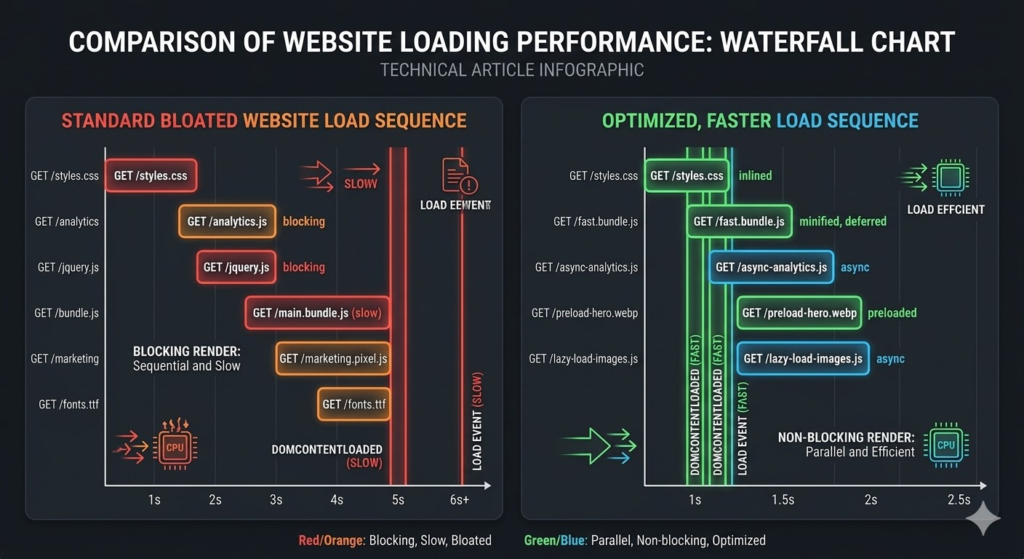
The Result:
By stripping away the unnecessary and optimizing the critical rendering path, we achieve a frictionless experience. A site that loads in under 1.5 seconds on a 3G mobile network isn’t magic; it’s precision engineering.